

Here is a productivity hack that quietly became one of the most useful things I ever built for myself: a technical bible. It did not start as a productivity hack. It started as a project document.
While working on an Adobe experiment, I wrote a single file that contained everything about the product I was building. The pitch, the architecture, the tech stack, the security model, the business model, the pricing logic, the personas, the risks, the weekly checklist. One document, one source of truth. I did not plan for it to become a system. It just happened because I was tired of re explaining myself to myself.
Then something interesting occurred. That document stopped being a project file. It became a reference I kept opening for everything else. Writing a prompt for an AI agent. Making a design decision. Prepping for a hackathon under time pressure. Every time, instead of starting from zero, I opened my technical bible and the foundations were already there.
Productivity Hack : Build your own technical bible
What a technical Bible actually is
It is not documentation in the classic sense, and it is not a pitch deck either. Think of it as the operating system for a project, written down once so your brain does not have to reload it every time.
A good technical Bible usually contains:
- The pitch, in more than one version (short, user facing, differentiation angle)
- Core features, described in enough detail that someone else could build them
- The architecture, layer by layer: frontend, backend, AI layer, database, deployment
- Security posture and the specific risks you are choosing to accept or mitigate
- The tech stack, named precisely, with the reasoning behind each choice
- Pricing and business model, including the psychology behind each price point
- Personas, with real pain points, not vague marketing fluff
- A weekly or phased checklist that turns the whole thing into something executable
None of this is impressive on its own. What makes it powerful is having all of it in one place, written in your own words (+ build faster with AI), so it becomes reusable.
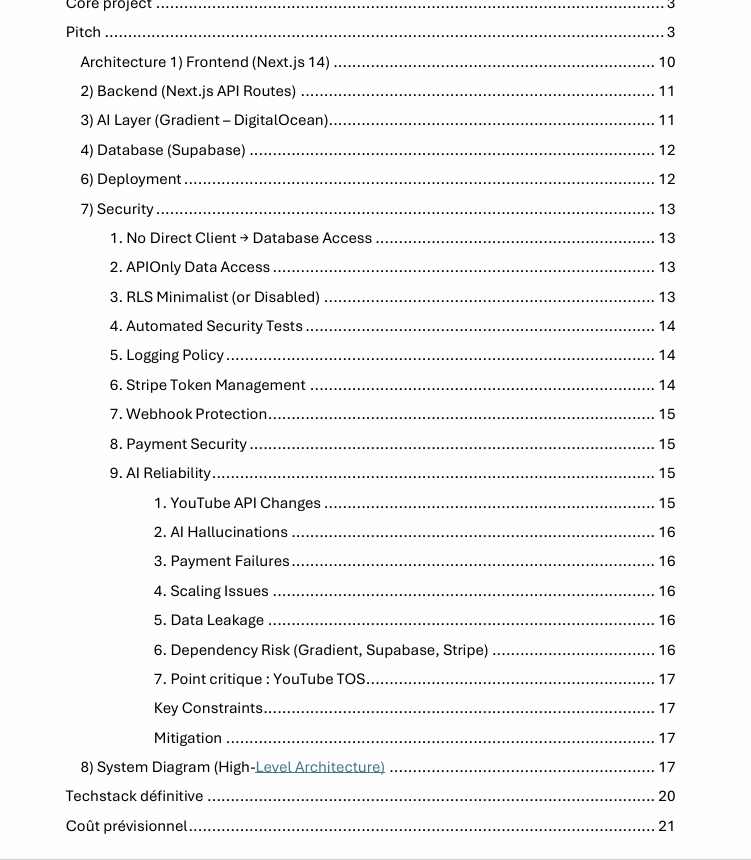
An extract of the “V1” definitive – In V2 Digital Ocean have been replaced by iterations.
Why it works better than notes scattered everywhere
Most internet advices are in reality organisation in fragments. A Notion page here, a voice memo there, half a plan in a Slack thread, the rest in your head. The problem is not that the information does not exist. The problem is retrieval cost. Every time you need it, you pay a tax in time and mental energy just to reconstruct what you already knew.
A technical Bible removes that tax. It is not about writing more, it is about writing once and reusing constantly.
Three places where mine paid off immediately.
Prompts : you can reuse context AI prompts. When you write a prompt for an AI agent, the quality of the output depends entirely on the quality of the context you give it. Instead of trying to remember and retype my architecture and constraints every single time, I now paste chunks straight from the Bible. Same context, same quality, every time, zero reconstruction cost.
Design. Design decisions stop being random when they are anchored to something. Colors, tone, persona pain points, all sitting in the same file means every design choice can be checked against the actual product logic instead of gut feeling on a random afternoon.
Hackathons/Events. This is where it shows the most. Under time pressure, you do not have the luxury of figuring out your positioning, your pricing logic, or your architecture from scratch. If you already have a Bible for a related project, you can fork the thinking in minutes instead of hours. The clock is the real enemy in a hackathon, and this hack buys you back the first two hours everyone else wastes on ideation.
How to actually build one
You do not need a system. You need one file and the discipline to keep dumping context into it as you go. See it as documentation for solo founders.
Start with the pitch. Write it three times: a technical version, a user facing version, and a one sentence version. If you cannot compress your product to one sentence, that is useful information too.
Then add the architecture as you build it, not after. Every time you make a real technical decision, write it down with the reasoning, not just the choice. Future you will thank present you.
Add security and risk thinking early, even a rough version. Naming the risks forces you to actually think about them instead of hoping they will not happen.
Add pricing and business model reasoning, not just numbers. The why behind a price point is more reusable across projects than the price itself.
Add personas with real pain points pulled from actual conversations or actual behavior, not invented ones. Fake personas produce fake insights.
Finish with a checklist broken into phases or weeks. This is what turns a document into a tool you actually use instead of a file you wrote once and forgot.
The real unlock
The value is not the document itself. It is what having it does to your speed. Every new prompt, every new design call, every new sprint under pressure gets faster because you are not rebuilding context from memory. You are pulling from a system you already trust.
Build the Bible once. Use it everywhere. That is the whole hack.
Bonus : theres now AI to build it, even for free with GPT or Gemini so…
See you soon !
Techie yours,
Angéline